Can your POS and Ecom Recognize the Same Shopper in Real Time?
A customer walks into your Portland location on a Saturday. She bought a $180 order from your website eleven days ago. She’s three points from a reward. She’s been on your email list for two years and has never used a coupon.
Does the cashier know any of that?
For most multi-store brands running an eCommerce channel alongside their locations, the honest answer is no—or not yet. The webstore knows. The email platform knows some of it. The POS knows she exists, maybe, if she gives her phone number and the clerk types it correctly. And the systems will reconcile sometime tonight, after she’s already left.
That gap is where loyalty programs quietly underperform and where real-time omnichannel loyalty programs come into play.
The retention spread is enormous
The most-cited figure here comes from Aberdeen Group: businesses with strong omnichannel engagement retain an average of 89% of customers, versus 33% for those with weak omnichannel strategies. It’s an older study, and it circulates mostly through secondary citations, so treat it as directional rather than precise.
The more recent and better-sourced number points the same way. McKinsey research finds that omnichannel shoppers carry roughly 30% higher lifetime value than single-channel shoppers.
The temptation is to read those figures as an argument for having an omnichannel program. They aren’t. Nearly every mid-market retail brand already has one in some form — points on the website, a card or phone-number lookup in stores, an email list stitched loosely across both.
What separates strong omnichannel performance from weak isn’t program existence. It’s whether the program behaves as one system in the moment the customer acts.
“Multichannel” and “unified” are not the same thing
Here’s the distinction that matters operationally.
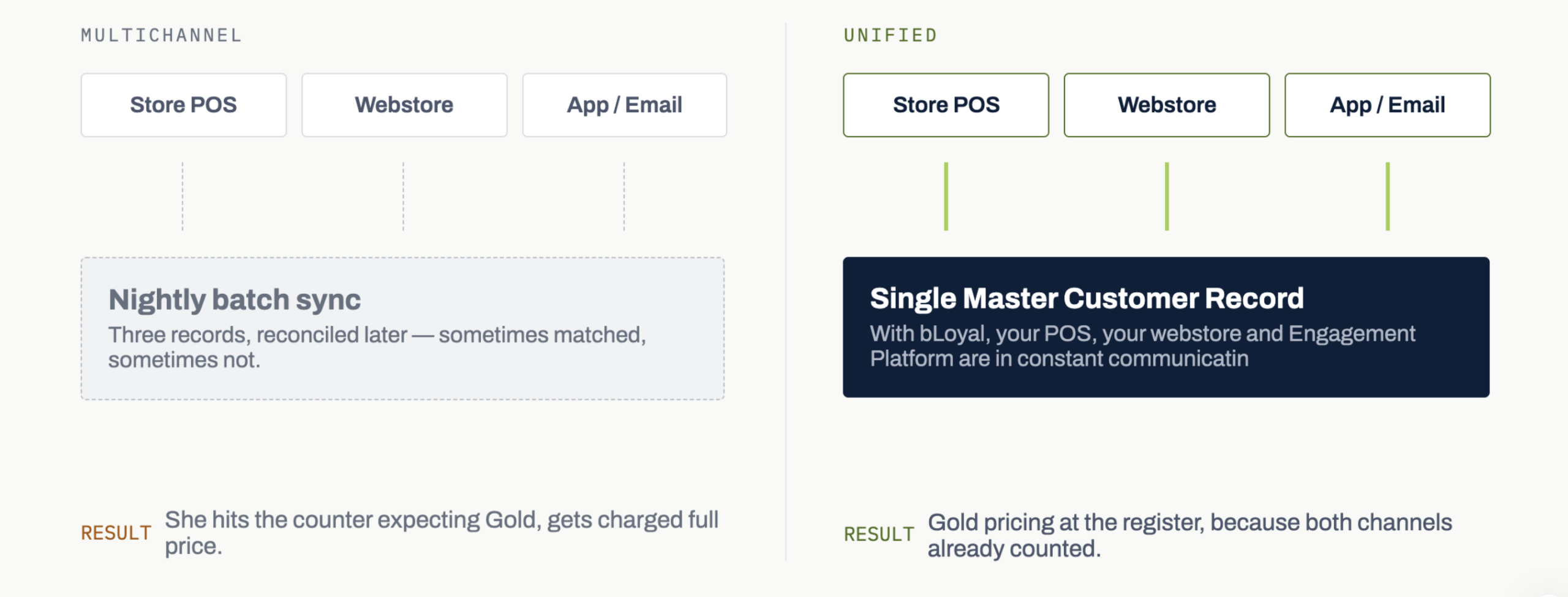
Multichannel means you sell in several places. Stores, website, maybe an app or a marketplace. Each channel has its own systems, and data moves between them on a schedule.
Unified means every channel reads from and writes to the same customer record, live. The register and the checkout page are two interfaces onto one profile.
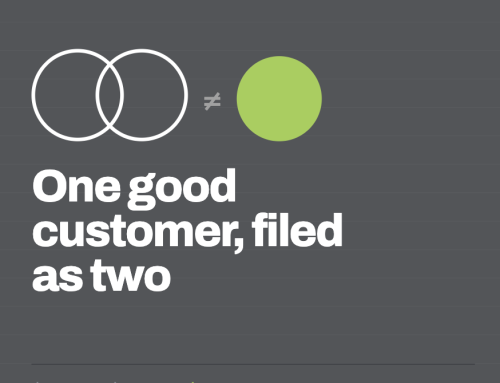
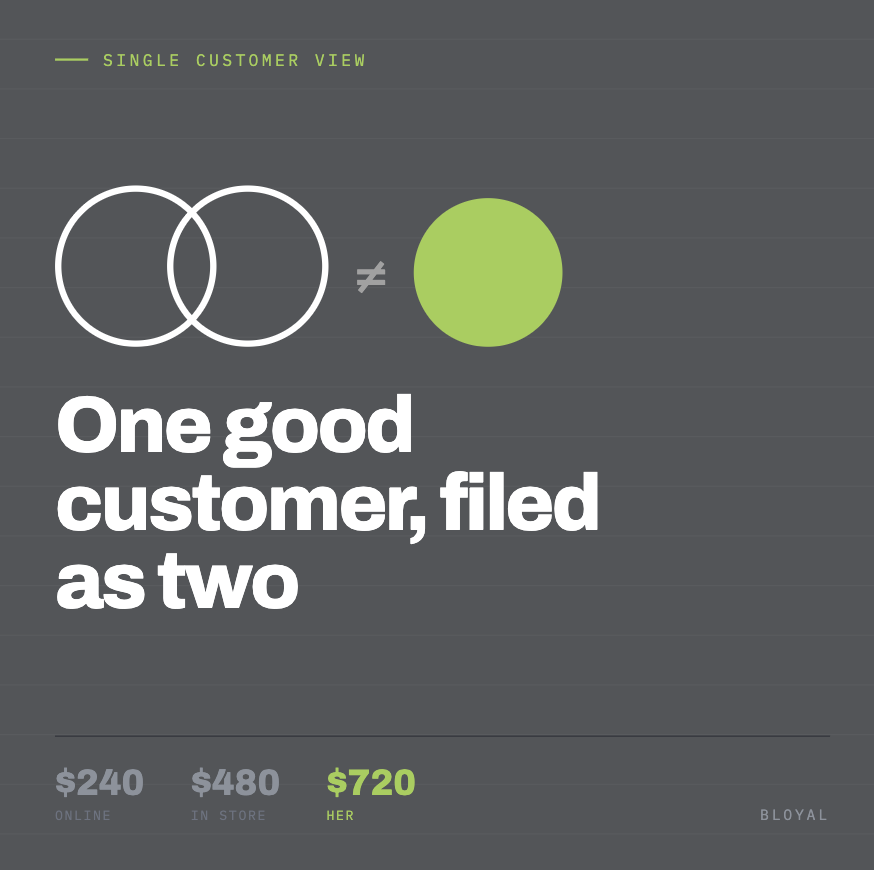
The difference sounds academic until you try to run a real campaign. Consider a straightforward tiered program: spend $500 in a rolling twelve months, unlock Gold, get 10% off. In a multichannel setup, a customer who spends $300 online and $250 in stores may not qualify at either — because neither system sees the full $550 until the nightly batch, and possibly not even then if the two records were never matched. She hits the counter expecting Gold, gets charged full price, and now you’ve created a service problem out of a loyalty investment.
Multiply that by every promotion, every tier evaluation, every “you have a reward waiting” email, and you get a program that leaks credibility. Customers don’t diagnose data architecture. They conclude the program doesn’t work.
The moment of truth is measured in seconds
The operative constraint is time. The real question isn’t whether your systems eventually agree — it’s whether the store, the app, and the eCommerce site recognize one shopper as one person in the moment that shopper acts.
This matters more than it used to, because shoppers now move between a brand’s app, its shelves, and its social channels within a single purchase journey. Around three in five shoppers use their phone in-store to compare prices or hunt for a better deal, and roughly three-quarters use a mobile device in-store at all.
That’s your window. Not tomorrow morning. Not next week’s segmented email. While she’s standing at the shelf with her phone out, comparing you to someone else.
A batch-synced loyalty program cannot compete in that window. It can only report on it afterward.
What real-time identity actually requires
Three things, in order:
- One profile, not one report. Many brands solve this halfway by piping everything into a reporting warehouse. That produces good dashboards and changes nothing at the register. The profile has to be readable and writable by the transaction systems — POS and eCommerce both — not just readable by analysts.
- Reliable identity resolution at the edge. Phone number, email, scanned loyalty card, app credential, or the payment card itself. Every store and the webstore need a fast, low-friction way to attach a transaction to the right person — and a way to merge duplicates when they inevitably appear. Every unmatched transaction is a permanent hole in the profile, and holes compound.
- Native integration rather than middleware chains. Every hop between systems introduces latency and failure modes. The fewer translation layers between your register and your customer record, the closer you get to real time — and the less time your team spends reconciling.
Where bLoyal fits
This is the specific problem bLoyal is built to solve. bLoyal is a loyalty, engagement, and marketing platform that connects directly to your POS and your eCommerce system, resolving every channel and every transaction into what bLoyal calls a Single Master Customer Record — including duplicate identification and merging, so one person stays one member.
That means native connections rather than custom middleware: Shopify, WooCommerce, and Magento on the eCommerce side; Clover, NCR Counterpoint, Korona POS, LS Retail, Microsoft Dynamics 365, Datasym, and RMH on the POS side; plus an open API for anything else in your stack.
Practically, for a brand with a dozen or a hundred locations plus a webstore, that delivers:
- One member credential across channels — the MyRewards mobile app, a scannable loyalty card, or a phone number at the register, all resolving to the same profile
- Real-time points, tier, and reward evaluation at the register on certified POS integrations, where bLoyal participates in the transaction flow rather than reconciling after it. The $300-online-plus-$250-in-store customer gets her Gold pricing at the counter, because the platform already counted both
- A single customer history spanning every channel, so segmentation and reporting reflect the actual customer rather than a channel-shaped fragment of her
- Automated journeys — welcome messages, post-purchase follow-up, inactivity reminders, and lapsed-customer win-back — triggered by behavior across all channels, not just the one that happened to capture it.
The question to take to your next planning meeting
Not “should we improve our loyalty program.” Ask instead:
If a customer who bought online eleven days ago walks into our third-busiest store right now, does the register know who she is, what she’s earned, and what she should be offered — before she pays?
If the answer involves the phrase “it depends on the sync,” you’ve found the highest-leverage fix available to you this year. It isn’t a new rewards structure. It’s one customer profile, live, everywhere you sell.
Sources: Aberdeen Group (89%/33% omnichannel retention, via secondary citation); McKinsey (omnichannel shopper LTV); industry mobile-in-store usage research.