The Single Customer View Problem in Multi-Location Retail
Direct answer: A single customer view is one record per shopper that combines every purchase, visit and reward across your website and all of your store locations. Most multi-location brands do not have one. The same person exists as a web record and a separate point-of-sale record, so lifetime value looks smaller than it is, segments are built on partial data, and loyalty balances split in two.
Here is a customer worth knowing about.
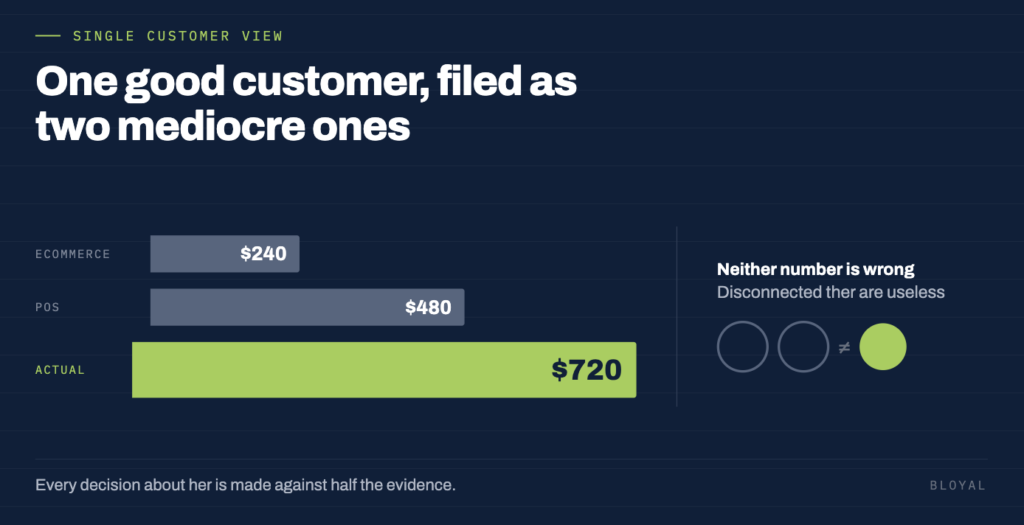
She buys online four times a year — replenishment orders, predictable, about $60 each. She also walks into your Portland store roughly monthly and spends $40 on things she wants to see before buying. Her real annual value to you is around $720.
Your systems do not see her that way. Your e-commerce platform sees a $240-a-year online shopper. Your POS sees a $480-a-year store shopper. Neither number is wrong. Both are useless.
She is not one good customer in your reporting. She is two mediocre ones. And every decision you make about her — which segment she lands in, which campaign she gets, whether she’s worth a win-back offer when she goes quiet — is made against half the evidence.
What a single customer view actually means
The phrase gets used loosely, so it’s worth being precise. A genuine single customer view has four properties:
- One record per person, not one record per channel.
- Every transaction attached to it — online orders, in-store tickets, returns, and redemptions, from every location.
- Updated in real time, not assembled overnight by a batch job.
- Readable by the systems that act on it — your marketing tool, your loyalty program, and the register.
Miss any one of those and you have something weaker: a reporting view, or a nightly export, or a partial profile. Those are useful. They are not a single customer view, and they will not hold up when a member asks a clerk why her points are missing.
Five signs yours is broken
You can run this audit yourself this week. It does not require a project.
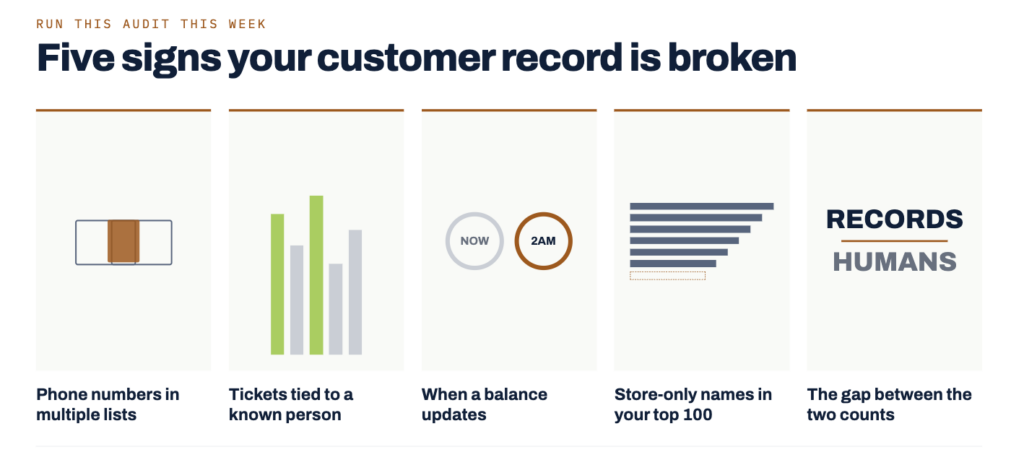
1. Pull a phone-number duplicate count
Export your web customer list and your POS customer list. Count how many phone numbers appear in both. Every match is one person being counted twice. If that number is above a few percent of your file, your reporting is materially understating customer value.
2. Ask what percentage of in-store transactions are attached to a known customer
In many multi-location brands it is under half. Anything not attached is revenue you cannot connect to a person — so it cannot inform a segment, trigger a journey, or count toward a reward.
3. Check how a member’s balance updates after an in-store purchase
Immediately, or tonight? If it’s tonight, your members will discover this before your reports do.
4. Look at your top 100 customers by lifetime value
Are any of them store-only? If your list is all online buyers, that is not because your best customers shop online. It is because those are the only ones you can measure.
5. Count your customer records
Compare the total to a reasonable estimate of how many actual humans have bought from you. A large gap is the whole problem in one number.
What the split actually costs
Understated lifetime value. Every customer who shops both ways looks smaller than she is. That distorts acquisition spend — you will underinvest in acquiring exactly the customers who are worth the most, because the ones who shop both channels are the ones being halved.
Mis-targeted campaigns. A win-back email to someone who was in your store on Saturday is worse than no email. It is not a neutral miss; it tells the customer you aren’t paying attention.
A loyalty promise you can’t keep. This is the expensive one. A program that says “earn and redeem anywhere” and then can’t produce a balance at the register has not just failed to delight — it has actively created a bad moment in front of a clerk and a queue.
Why this happens to good teams
Nobody chooses a split customer record. It accumulates.
The e-commerce platform arrives with its own customer table. The POS arrives with a different one. A loyalty app is added, holding a third. An email platform syncs a subset of the first and none of the third. Each system is doing its job correctly. No system owns the person.
Two things then keep it broken. The first is batch sync — a nightly CSV means every system spends most of the day wrong, and any real-time promise made to a customer is a promise made against stale data. The second is no shared identity key: if online identity is email and in-store identity is a phone number or a card swipe, there is nothing to match on, and the records never meet.
How brands fix it
The fix is not a data project. It’s a sequencing decision.
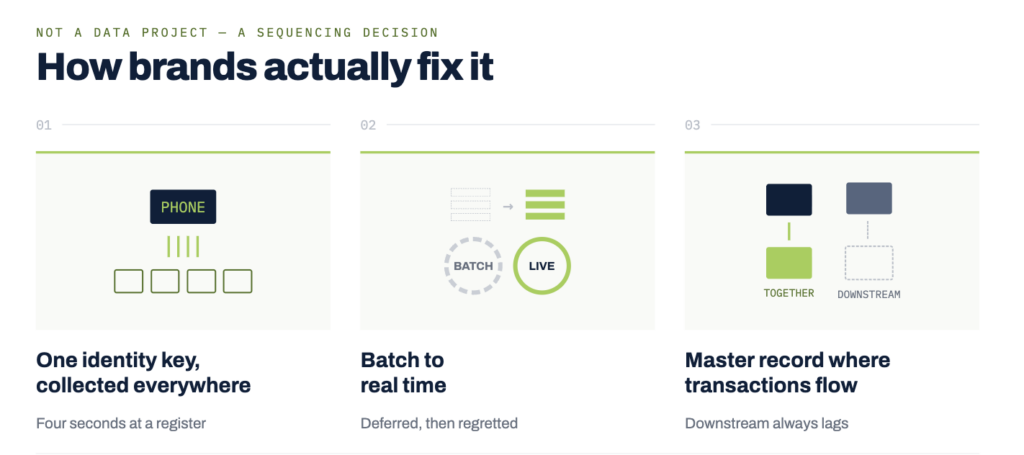
Pick one identity key and collect it everywhere. Phone number usually wins, because it works at a register in four seconds and a customer can recite it without spelling anything.
Move from batch to real time. This is the step most often deferred and most often regretted. Batch is fine for reporting and fatal for anything a customer experiences.
Put the master record where transactions already flow. A customer record that lives downstream of your POS will always lag it. One that lives with it does not.
This is the architecture bLoyal is built around — a single master customer record that every channel writes to and reads from, with native connections to the POS and e-commerce platforms you already run. The point is not the platform. The point is that the record has to sit where the transactions are, or it will always be catching up.
Once the record is whole, the next question is what your loyalty program can actually do with it — which is where most programs quietly fail.
Start with the count
Before program design, before tier structure, before picking a vendor: run the duplicate count. It takes an afternoon and it will tell you whether you’re designing a loyalty program for your customers or for two halves of them.
And better yet! If you are ready to connect your POS and e-commerce with bLoyal to make sure everything runs smoothly, request a demo in the link below.