Inside Circle K’s New Rewards Ladder
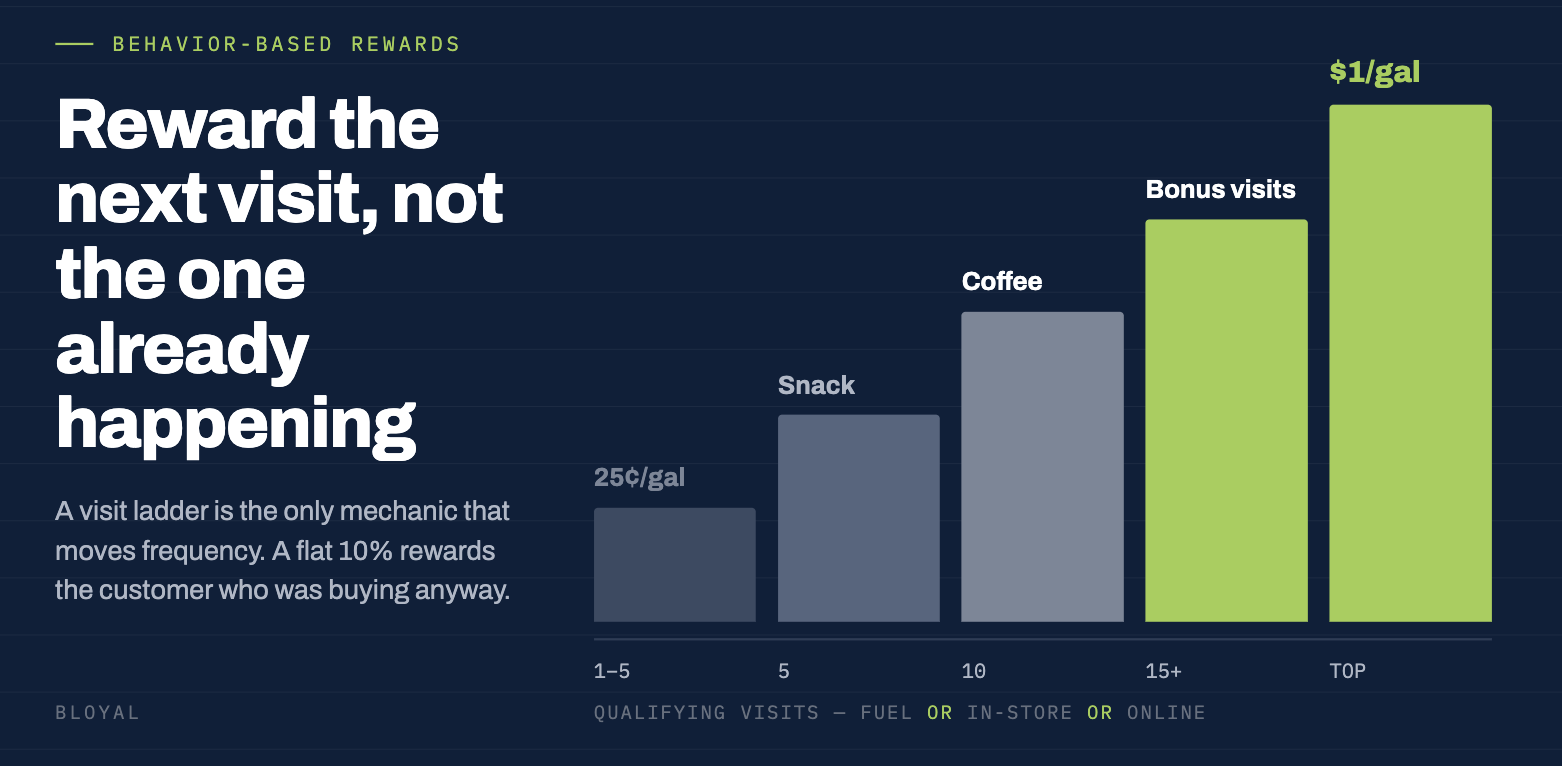
Circle K announced a full redesign of its Inner Circle program in late July, going live this September. The new structure is built to be understood at a glance: new members get 25 cents off per gallon on their first five fill-ups, and from there members climb a visit-based ladder, a free Polar Pop or snack at five visits, a free coffee or energy drink at ten, scaling up to $1 off per gallon at the top.
Crucially, a “visit” isn’t fuel-only. Circle K counts a qualifying fuel purchase or an in-store transaction over a small threshold. Coffee runs count. Snack stops count. On top of that sit personalized challenges that award bonus visits based on how each member already shops.
Most coverage treated this as a fuel-pricing story. It’s worth reading as an infrastructure story instead.
Because if you map what has to be true for that program to work, you find a set of requirements that a lot of multi-store brands with an eCommerce channel cannot currently meet. Not for budget reasons. For plumbing reasons.
Unpack what the program demands
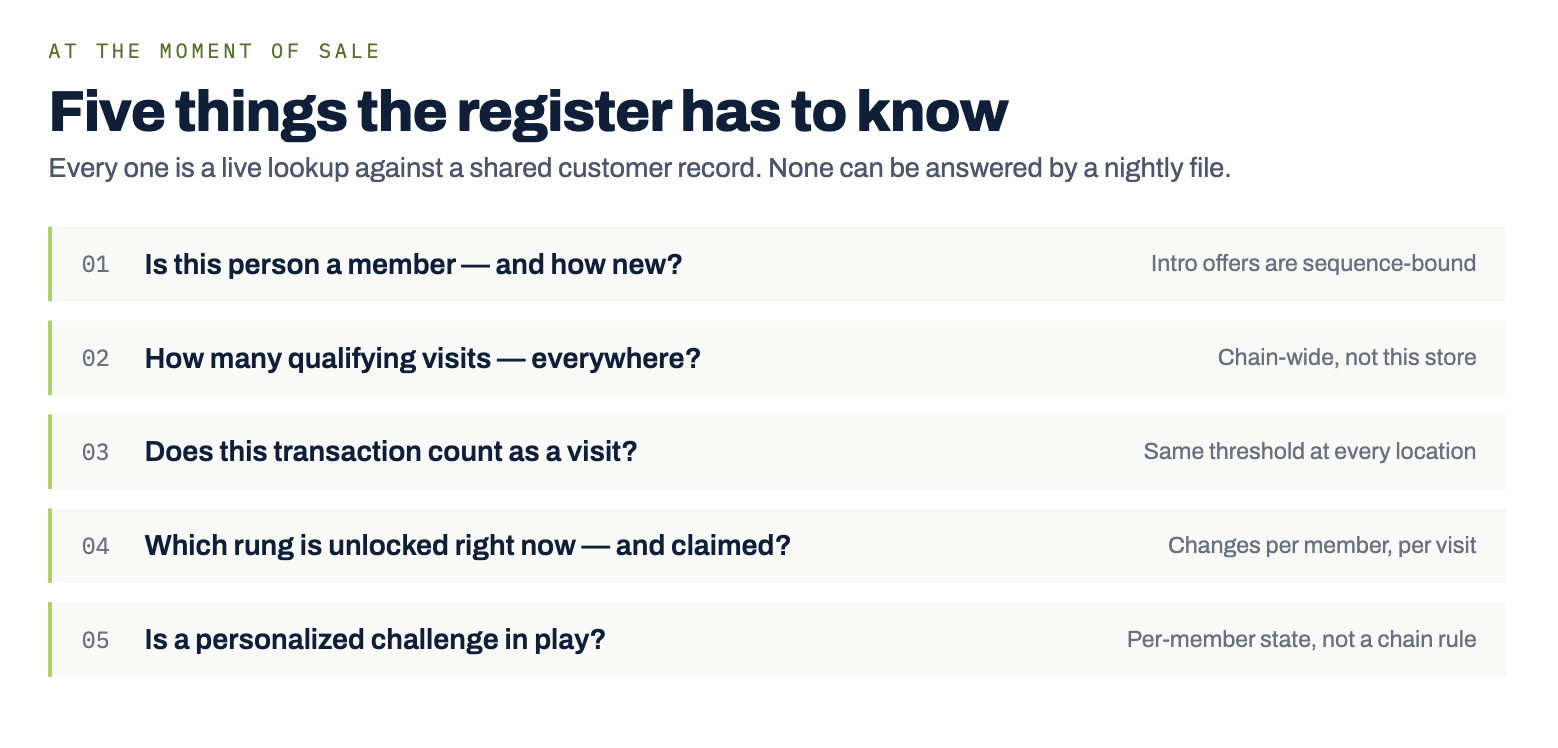
Look at what the register has to know, at the moment of sale:
- Is this person a member, and how new are they? Enrollment date matters, because the intro offer is time- and sequence-bound.
- How many qualifying visits has this person made… everywhere? Not at this store. Across the entire chain.
- Does this transaction qualify as a visit? A visit is not the same as a transaction, and the threshold has to be applied identically at every location or members will get different answers in different stores.
- Which reward is unlocked right now, and has it been claimed? The ladder means the answer changes per member, per visit.
- Is there a personalized challenge in play? Individually targeted bonus mechanics require per-member state, not a chain-wide rule.
Every one of those is a lookup against a shared, current customer record. None of them can be answered by a nightly file.
The promotion you can’t run
Here’s the pattern we see constantly. A marketing team brings a genuinely good idea to a planning meeting, a visit-streak reward, a “third purchase in 30 days” accelerator, a category-crossing bonus. Someone from operations or IT asks how it will be configured and enforced across every location plus the website. And the idea gets quietly downgraded to a flat percentage off, because the flat percentage is the only thing the systems can execute reliably everywhere.
That downgrade is invisible in your marketing calendar. It shows up only as mediocre program performance.
The cost isn’t the discount you gave. It’s the behavior you failed to shape. A flat 10% off rewards the customer who was going to buy anyway. A visit-based ladder rewards the next visit specifically which is the only thing that actually moves frequency. That’s precisely why Circle K restructured around visits rather than spend.
Now add the eCommerce channel
Circle K’s problem is hard because it spans thousands of physical locations. Your problem has a different shape and is arguably harder in one respect: your customers buy from you both in stores and online, often in the same month.
Which raises a question worth answering explicitly before you design your next program: do online purchases count?
There’s no universally right answer. But there is a universally wrong outcome, which is that the answer varies depending on which system happens to process the transaction. If a customer’s three online orders don’t advance her toward the in-store visit reward, and nobody ever told her that, you have built a program that punishes her for shopping the way you asked her to shop.
Common failure modes:
- Online orders accrue points but don’t count toward visit- or frequency-based tiers
- In-store purchases don’t appear in the webstore’s account view, so the customer thinks they were lost
- A reward earned online can’t be redeemed at the register, or vice versa
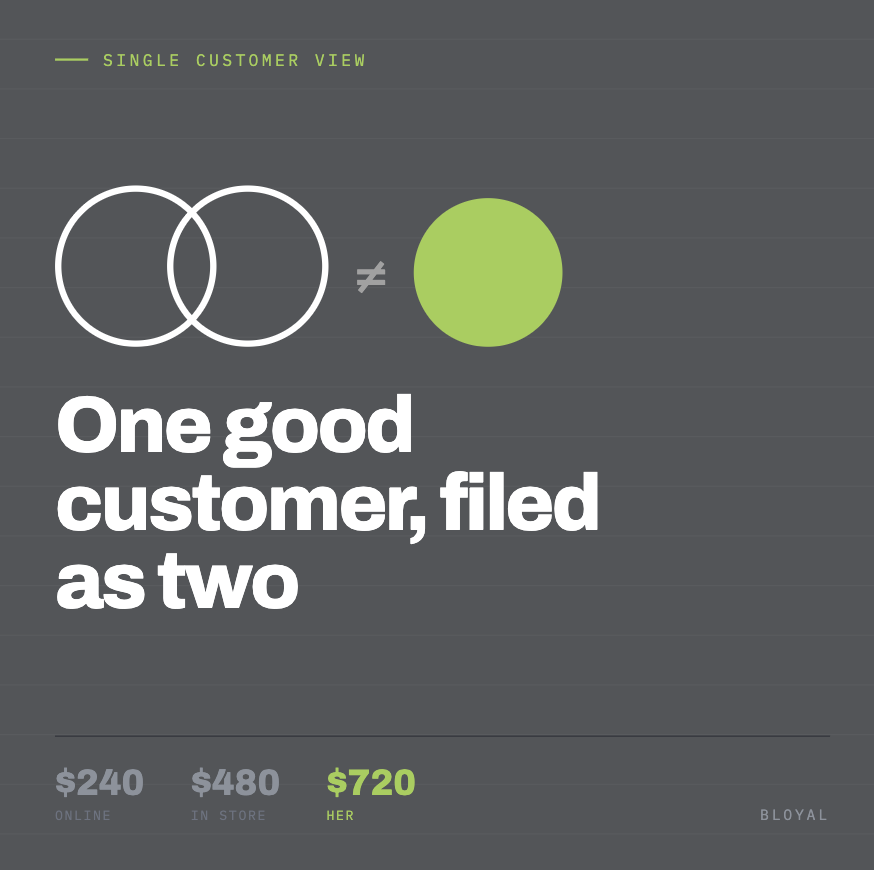
- The same person exists as two members, splitting her own progress in half
Each of these is a data architecture symptom presenting as a customer service complaint.
What it takes to run this well
Three capabilities, and they’re specific:
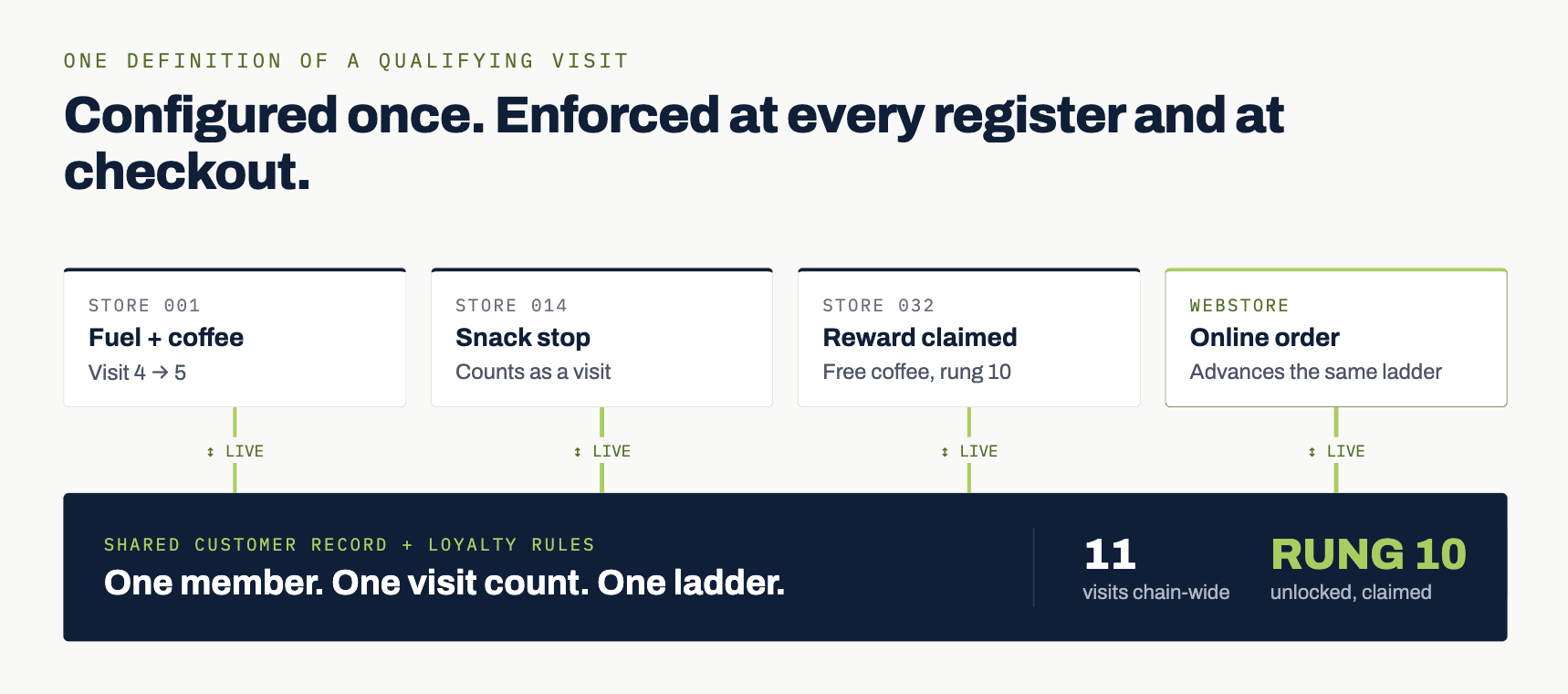
Rules that live in one place and execute everywhere. The definition of a qualifying visit, the ladder thresholds, the eligible products are configured once and enforced identically at every register and at web checkout. If a rule has to be re-created per location or per channel, it will drift, and drift is what produces the “that’s not what my app said” conversation at the counter.
Real-time evaluation, not overnight recalculation. The unlocked reward has to be resolved during the transaction. This is the requirement that eliminates most batch-based approaches outright, because a member’s fifth visit and her sixth carry different entitlements and both might happen this week.
Transaction-level detail, not just balances. This one is our recommendation rather than something Circle K has announced, but it’s where the real upside sits. If your platform stores only a running point total, you can never build “escalates faster for coffee buyers” or “bonus for a first purchase in a new category.” Those require the purchase history underneath and they’re the mechanics that shift basket composition rather than just frequency.
Where bLoyal fits
bLoyal is built for this class of program specifically: multi-location brands that also sell online and want behavior-based rules rather than flat discounts.
Because bLoyal connects directly to both your POS and your eCommerce platform, the loyalty rules live in one system and execute at every touchpoint. Native integrations include Clover, NCR Counterpoint, Korona POS, LS Retail, Microsoft Dynamics 365, Datasym, and RMH for stores, and Shopify, WooCommerce, and Magento for online, with an open API for the rest of your stack.
What that makes possible:
- Visit-, frequency-, and streak-based rewards with one definition of what qualifies. bLoyal records every activity, so the ladder counts the whole customer relationship rather than one channel’s slice of it
- Tiers based on spend or visits, so you can build a Circle K–style ladder rather than being forced into a spend-only structure
- SKU- and category-level targeting driven by real purchase history, which is what enables accelerators beyond simple spend thresholds
- Real-time reward and discount evaluation at the register on certified POS integrations, where bLoyal becomes part of the transaction flow so the right price appears on this transaction, not on a receipt after the next sync
- One member credential, MyRewards app, scannable card, or phone number/email so a customer’s progress never splits across two accounts
- Automated journeys that fire on the behavior itself: a reminder when someone is one visit from the next rung, a win-back when a streak breaks.
The test
Take your most ambitious promotion idea from the last twelve months — the one that got downgraded. Ask what specifically blocked it.
If the blocker was “we couldn’t enforce that at every location,” or “the webstore can’t see in-store visits,” or “we’d have to reconcile it manually,” then the constraint was never your creativity or your promotional budget. It was the gap between your POS, your eCommerce platform, and your loyalty data.
That gap is closeable. And closing it is what turns a rewards program into a frequency engine.