

If you run an e-commerce site plus three or more physical stores, the deciding question is not which platform has more features. It is whether loyalty and messaging write to one customer record and whether that record sees your register. Most platforms do one or the other. Seven are compared below, verified October 2026.
Omnichannel Loyalty Platforms Compared
The question that actually sorts this market
Feature lists have converged. Every platform in this comparison does points, tiers, referrals and segments, and comparing them on those terms produces a table where everyone wins.
Two structural facts decide fit instead, and neither shows up on a feature grid.
Is loyalty and messaging one product, or two things you stitch together?
Klaviyo sends beautifully and has no loyalty product. Annex Cloud runs sophisticated loyalty and has no sending channel. LoyaltyLion sends through Klaviyo. Marsello has both but prices marketing as an add-on. None of that is hidden — it is just rarely the thing buyers compare.
When the two live apart, somebody owns the join. Usually that is a nightly export, a Zapier chain, or an ops person reconciling member balances on a Friday afternoon.
Does the customer record see the register?
This is the one that bites multi-location brands. If a clerk cannot look up a member and apply a reward while the customer is standing at the counter, the program exists online and nowhere else.
Ask what happens to points when a member buys in store. The answers range from “applied in the cart before payment” to “imported overnight” to “you’d use our API for that.” Those are three different products wearing the same category label.
A related question with a surprising answer: most vendors publish no sync frequency at all. Of the seven platforms here, exactly one states a figure in its own documentation — and that document contradicts itself.
Where bLoyal fits
bLoyal was built for that exact moment at the counter.
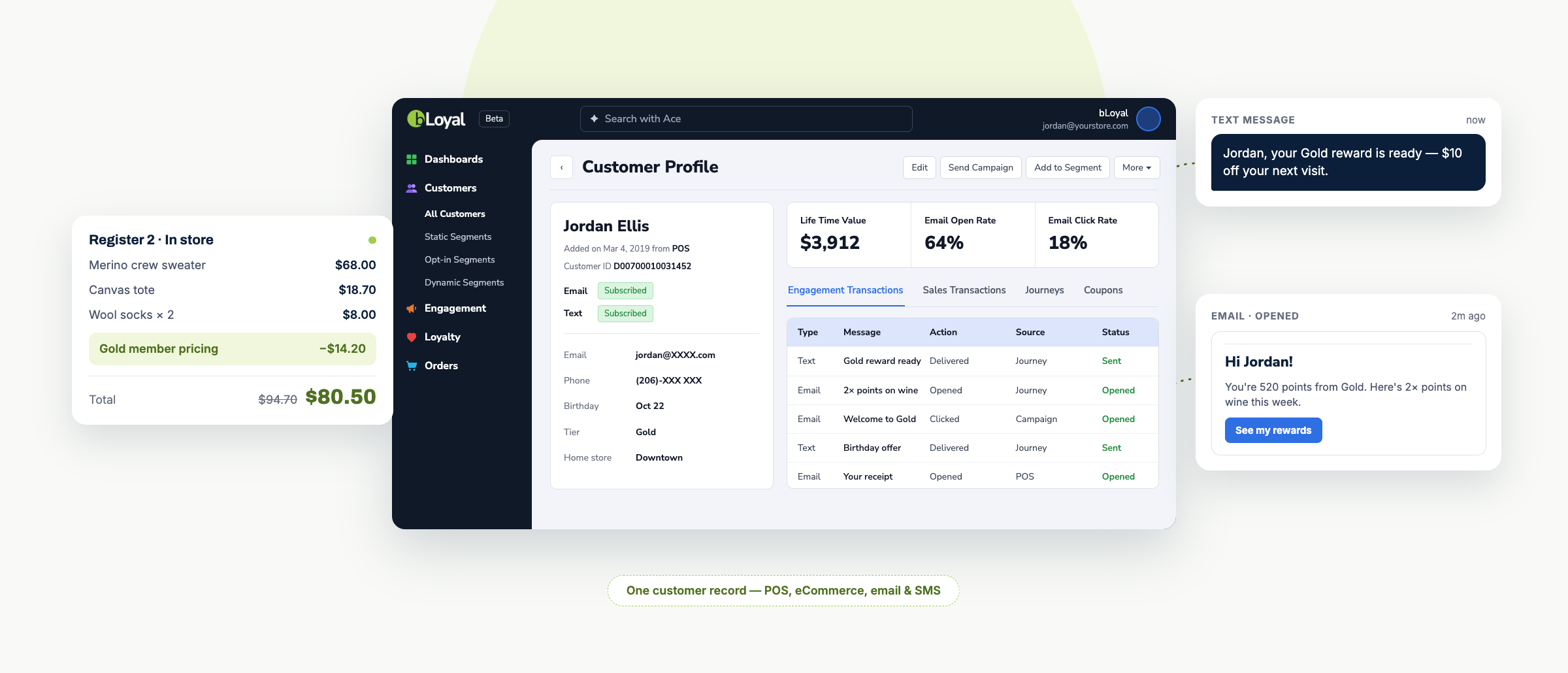
A member gives their phone number. The cart re-prices while they are still standing there — points accrue, a reward applies, a club discount lands, all before payment is taken. No second system, no lookup, no “I’ll add that for you next time.” The clerk does one thing and the right thing happens.
That is not a small convenience. It is the difference between a program members use and a program they forget they joined. Redemption is what drives enrollment, and the register is where multi-location brands sign up members fastest.
Underneath it, every one of those transactions writes to the same master customer record your website writes to. So tomorrow morning’s segment reflects last night’s sales — in store and online, in one view — instead of whatever your last export happened to catch.
Three categories, not ten vendors
Sorted by the two questions above, the market falls into three groups. Each one hands you a different bill.
-
Messaging platforms with no loyalty product.
Klaviyo is the example, and it is excellent at sending. Loyalty appears there as an integration category, not a Klaviyo product, so you buy the sending layer and source the program somewhere else. The bill is a second vendor, a second contract, and a seam between them that belongs to you.
-
Loyalty platforms with no sending channel.
Annex Cloud, Yotpo Loyalty and LoyaltyLion run the program and push data into an email tool you already pay for. LoyaltyLion is explicit about it: its Flows send through Klaviyo. The bill here is lag. Your campaigns go out against whatever the last sync delivered, and the distance between what a member did yesterday and what your email knows today is exactly where relevance dies.
-
Loyalty and messaging on one record.
bLoyal, Marsello and Como Sense. There is nothing to join because nothing was separate, which changes three things you can measure:
-
- Members actually use the program. A reward that only works online is a reward most members never claim. When the balance is live at the register, the clerk can apply it while the customer is still at the counter — and a program people redeem is a program people enroll in.
- Your marketing runs on real-time data. Segments rebuild as transactions land, from the register and the website both. The member who bought in store on Saturday gets Monday’s email about what pairs with it — not a generic send aimed at who they were last month.
- You stop over-discounting. One record means you see a customer’s full value across web and every location. Most brands discover they have been spending acquisition offers on people who already shop with them twice a month.
Inside that third group the distinctions are real. Marsello sells marketing as a paid add-on on top of a per-site loyalty plan. Como is built F&B-first.
bLoyal is the one built for the register you already own.
Clover, NCR Voyix, Korona, Retail Management Hero, Microsoft Dynamics 365, LS Retail, Datasym — none of the other six platforms in this comparison publishes an integration with any of them. If your POS is on that list, this is not a close call. It is the difference between a platform you can run on Monday and one that would have you rebuilding your stack first.
And you do not have to bet the business to find out. Start with the Engagement Solution on its own: email, SMS and automated journeys running on live POS and ecommerce transaction data, writing to the same master customer record as everything else. Keep your current loyalty program exactly where it is. Then watch what segments built on last night’s sales do to your open rates.
When you want more — loyalty, subscriptions and memberships, promotions, gift cards — you turn it on. Same record, same data, nothing to migrate. That is an upgrade, not a replatform.
The comparison
Every cell below comes from the vendor’s own published pages, verified October 2026. Where a vendor publishes nothing on a dimension, the cell says so rather than guessing — silence is not the same as a nightly batch.
| Platform | Loyalty + messaging | POS systems named publicly | Sync frequency in vendor docs | Pricing published |
|---|---|---|---|---|
| bLoyal | One product, one master customer record | Clover, NCR Voyix, Korona, Retail Management Hero, Microsoft Dynamics 365, LS Retail, Datasym | In-flow: the cart re-prices while the customer is at the counter | Yes — from $49/mo per store |
| Klaviyo | Messaging only — no loyalty product | Lightspeed R-Series documented | Its Lightspeed doc says both "every hour" and "synced in real-time" | Yes, usage-based |
| Marsello | Both; marketing is a paid add-on | Lightspeed Retail, Lightspeed Hospitality, Shopify POS, Clover, Cin7 Omni, Heartland Retail | Not stated | Yes — from $60/mo per site, marketing from $15/mo |
| Annex Cloud | Loyalty only — no sending channel | None named publicly | Not stated | No |
| Como Sense | Both, as modules | Heartland, Oracle Micros, NCR, Toast, ICRTouch, PixelPoint | Claims real-time customer data | No |
| Yotpo Loyalty | Loyalty only; reportedly exiting email/SMS | Square | Not stated | Yes — loyalty from $199/mo |
| LoyaltyLion | Loyalty only — sends via Klaviyo | Shopify POS, ConnectPOS | Not stated | Yes |
One pattern is worth stating plainly. None of the six comparison platforms publishes an integration with NCR Voyix/Counterpoint, Korona, Retail Management Hero, Microsoft Dynamics 365, LS Retail or Datasym.
If you run one of those systems, the shortlist is shorter than the category suggests — not because the others are weaker, but because they were built for the Shopify and Lightspeed ecosystem and say so.
Two caveats on the table itself. Klaviyo’s hourly figure is documented for its Lightspeed integration specifically and should not be read as how Klaviyo behaves everywhere. Yotpo’s email and SMS exit is reported by Attentive, its named partner, rather than stated in Yotpo’s own words.
Where bLoyal wins
Five reasons, and you can verify every one of them before you talk to us.
Your register is already on the list.
Clover, NCR Voyix, Korona, Retail Management Hero, Microsoft Dynamics 365, LS Retail, Datasym. Not one of the other six platforms in this comparison publishes an integration with any of them. If you run a specialty retail POS, this stops being a feature comparison. Most of this market built for Shopify and Lightspeed and left you out, and we did not.
The reward lands before the payment does.
Not synced overnight. Not available through an API your developer could wire up next quarter. The cart re-prices while the customer is still at the counter, and the clerk does nothing but ring the sale. That single behaviour is why our members redeem — and redemption is the only thing that makes enrollment worth anything.
Loyalty and marketing are not two systems pretending to be one.
Every transaction, in every store and on your site, writes to the same master customer record. There is no export, no sync window, no seam for somebody on your team to own. Your Tuesday campaign knows what happened Monday night because it is reading the same record the register wrote to.
It starts at $49 a month per store.
That is less than Marsello’s entry loyalty plan before you add its marketing module, and a quarter of what Yotpo charges for loyalty alone. You do not need a procurement cycle or a signature to find out whether it works. You need a month.
You can start small and never migrate.
Run the Engagement Solution on its own — email, SMS and automated journeys on live POS and ecommerce data. Keep your current loyalty program running untouched. When you want loyalty, subscriptions and memberships, promotions or gift cards, you switch them on against the same record. Nothing moves. Nothing breaks. It is an upgrade, not a replatform.
We publish the comparison table above because we are happy to be measured against it. Check the links. Every vendor claim in this post comes from that vendor’s own page, including ours.
Seven questions to ask on any demo
Take these to every vendor, including us. The answers separate platforms faster than any feature list.
- Show me a clerk redeeming a reward at the register. Not a slide — the actual screen. Count the clicks. This is where program adoption lives or dies.
- What happens to a member’s balance when they buy in store? Listen for “applied in the cart,” “imported overnight,” or “you’d use the API.” Three different products.
- Is your loyalty and your email the same product, or two that talk? If two, ask who owns the join and what breaks when it fails.
- Where is your sync frequency documented? Ask for the URL. Most vendors cannot produce one.
- What happens to the program if your platform goes down for a week? Ahold Delhaize’s US banners spent a week in October 2026 unable to let members redeem rewards. Ask whether the register keeps working offline.
- Name a customer running my POS, at my store count. Not a logo wall — a reference you can call. Scale and stack both matter.
- What does year two cost? Per-site pricing, SMS credits, add-on modules and implementation fees land differently once you add stores.
If a vendor answers all seven cleanly, they have thought about multi-location retail. If question one produces a slide instead of a screen, you have learned something important.
Frequently asked questions
Sources
All pages opened and verified October 2026.
- bLoyal integrations, Our Solution and Clover integration pricing
- Klaviyo and its Lightspeed integration doc
- Marsello integrations and pricing
- Annex Cloud integrations
- Como Sense
- Yotpo Loyalty and pricing; Attentive on Yotpo’s SMS and email exit
- LoyaltyLion integrations
- PAR Punchh
- Grocery Dive on the Ahold Delhaize outage

Leave A Comment